What the Cyber Resilience Act covers
The EU Cyber Resilience Act — Regulation (EU) 2024/2847, almost always shortened to CRA — is a horizontal cybersecurity rulebook for hardware and software sold in the European Union. It does not regulate how a product looks or how fast it boots. It regulates whether the product is secure by design, whether its manufacturer keeps fixing vulnerabilities after the sale, and whether the manufacturer tells the authorities quickly when something is actively being exploited.
The Regulation entered into force on 10 December 2024 and applies in three stages rather than one. That staged calendar is the single most misreported part of the CRA, so it is worth stating plainly: the reporting duty is already live, the rest of the technical requirements are not, and the difference matters to anyone buying or building industrial panel PCs, touch monitors, digital signage and embedded computers.
This article is written for the people on the buying side of that transaction — the system integrator, the kiosk builder, the signage network operator, the distributor — and for their suppliers. It explains what the CRA actually requires, why a connected touch display is in scope, which dates are real, and the questions that should be asked before a purchase order rather than after.
Why panel PCs, touch monitors and signage are in scope
The CRA applies to products with digital elements, defined as a software or hardware product, and its remote data processing solutions, whose intended purpose or reasonably foreseeable use includes a direct or indirect logical or physical data connection to a device or network. That definition is deliberately broad, and it was written to reach exactly the kind of equipment this site sells.
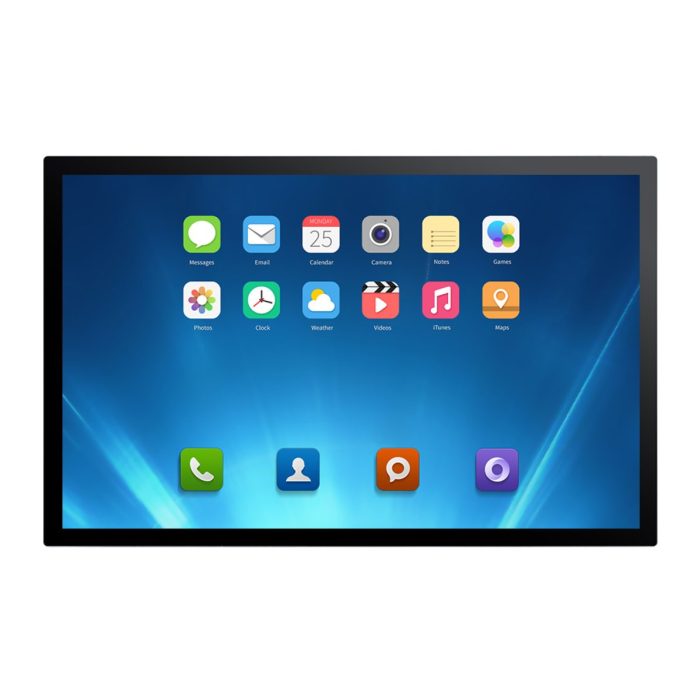
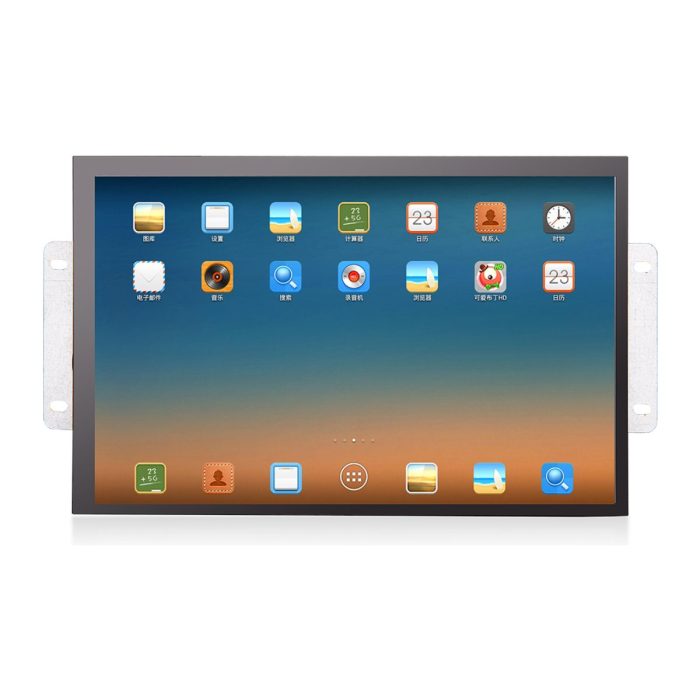
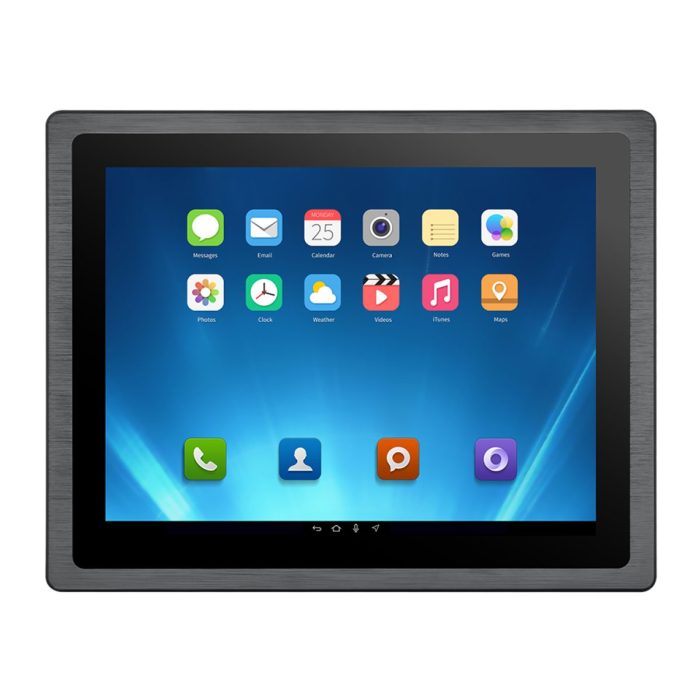
An industrial panel PC running Windows or Android, with Ethernet, Wi‑Fi or a USB port, is a product with digital elements. So is an OPS PC module slotted into an interactive flat panel, an industrial touch monitor used as the display half of a control station, and a commercial digital signage display on a content management network.
Two nuances are frequently missed. First, the CRA also covers components placed separately on the market. A PCAP touch overlay or an infrared touch PCBA that ships alone to a frame builder can therefore be a product with digital elements in its own right, depending on how it is documented and sold. Second, a display with no network connection at all and no software update path is a genuinely different case — but a USB port that a technician uses to load firmware is not a get-out, because the definition includes indirect connections.
In practice, the safest reading for an equipment builder is this: if the device has an operating system, a firmware stack or a communications interface, assume it is in scope and work backwards from there.
The three dates that matter
The CRA has three application dates, and only the third one gets quoted in most marketing material. The first is the one already affecting tenders today.
| Date | What starts applying | Practical meaning |
|---|---|---|
| 11 June 2026 | Chapter IV — notification of conformity assessment bodies | Member States began designating notifying authorities and notified bodies |
| 11 September 2026 | Article 14 — vulnerability and incident reporting | Manufacturers must already report actively exploited vulnerabilities and severe incidents |
| 11 December 2027 | Main obligations — design, conformity assessment, CE marking, documentation | Full technical compliance and the EU declaration of conformity |
Two supporting deadlines explain why the compliance market is moving now. Member States are asked to ensure, by 11 December 2026, that there is a sufficient number of notified bodies available to carry out conformity assessments — the point being to avoid a bottleneck before the 2027 date. And the Commission is required to publish guidance for economic operators; practical guidance for manufacturers, developers and businesses was published on 27 July 2026.
For context, the CRA is one of several EU product rules moving at the same time. The Machinery Regulation (EU) 2023/1230 applies from 20 January 2027 and replaces the Machinery Directive, and it also touches on safety-related control systems. An industrial control panel project sold into the EU can therefore be discussing two separate conformity files in the same meeting.
Support period: at least five years, disclosed at purchase
This is the requirement that changes hardware procurement most directly, because it is a number printed on a quotation rather than a technical detail hidden in a datasheet.
A manufacturer must determine a support period that reflects how long the product is expected to be in use, taking into account reasonable user expectations, the nature of the product and its intended purpose. The support period must be at least five years, unless the product is expected to be used for less than five years, in which case it must match that expected use time. During the support period the manufacturer has to handle vulnerabilities in the product and its components effectively.
Two further obligations sit on top of it. Every security update made available during the support period must remain available for a minimum of ten years after it was issued, or for the remainder of the support period, whichever is longer. And the end date of the support period, including at least the month and the year, must be clearly specified at the time of purchase — on the product, its packaging or by digital means. Where it is technically feasible, the product must also notify users when that end date has been reached.
Read together, those rules mean an EU-facing buyer can no longer accept “lifetime support” or “firmware updates available” as an answer. The question becomes: what is the support period end date for this exact model, and who signs for it?
Reporting obligations: 24 hours, 72 hours, 14 days
Article 14 has been in force since 11 September 2026, more than a year before the rest of the technical requirements. It covers two events: an actively exploited vulnerability, meaning reliable evidence that a malicious actor has exploited a weakness without the owner’s permission, and a severe incident that affects the product’s ability to protect availability, authenticity, integrity or confidentiality of data or functions, or that leads to malicious code being introduced.
| Stage | Deadline | Content |
|---|---|---|
| Early warning | Within 24 hours of becoming aware | Baseline notice, suspected malicious intent, Member States affected |
| Notification | Within 72 hours of becoming aware | General information on the product, the vulnerability and mitigations |
| Final report — actively exploited vulnerability | Within 14 days after a corrective or mitigating measure is available | Description, severity, impact and the security update issued |
| Final report — severe incident | Within one month of the 72-hour notification | Detailed description, likely root cause, applied and ongoing mitigations |
All notifications go through one channel: the CRA Single Reporting Platform (SRP) operated by ENISA, which routes the report to the CSIRT of the Member State where the manufacturer has its main establishment. Reports sent by email or through a national portal do not satisfy the obligation. A manufacturer outside the EU that has no main establishment in the Union reports through the CSIRT of the Member State where its authorised representative, importer, distributor or largest user base sits, in that order of priority.
The manufacturer must also designate a single point of contact that users can identify easily, and must inform affected users of the vulnerability or incident along with the mitigations they can apply. Both requirements are also reflected in the user information required by Annex II, which is why a modern datasheet increasingly carries a security contact address next to the sales address.
One limit is worth knowing because it is often overstated in supplier presentations: for a manufacturer that qualifies as a microenterprise or small enterprise, the 24-hour deadline cannot attract an administrative fine under Article 64(10). The reporting duty itself does not disappear; only the financial penalty for missing that specific first deadline does.
SBOM, vulnerability handling and update policy
Part II of Annex I sets out the process obligations that sit behind the reporting duty, and these are the ones a hardware supplier has to be able to demonstrate in a technical file.
- Software bill of materials. Identify and document vulnerabilities and components, including an SBOM in a commonly used, machine-readable format covering at least the top-level dependencies.
- Remediate without delay. Address vulnerabilities and provide security updates; where technically feasible, security updates must be supplied separately from functionality updates.
- Test and review. Apply effective and regular tests and reviews of product security.
- Disclose fixed vulnerabilities. Publish a description of the vulnerability, the affected product, the impact and severity, and remediation guidance once an update is available — with a narrow, justified exception where publication would create more risk than it removes.
- Coordinated vulnerability disclosure. Put in place and enforce a CVD policy, including a contact address for reporting.
- Secure update distribution. Provide mechanisms to distribute updates securely, automatically where applicable, and free of charge for security fixes.
For an appliance-style product such as a panel PC, the SBOM is usually the hardest item, because it reaches into the operating system image, the drivers, the browser and the third-party libraries that ship with the image. A supplier that cannot produce, at minimum, the operating system version, the kernel version, the firmware revision and the main application runtimes is not yet in a position to support a customer’s technical file.
Who counts as the manufacturer under OEM and ODM
This is the clause that surprises most buyers, and it is the one that matters when a company rebrands a touch computer and sells it into the EU.
The CRA defines the manufacturer as the person who develops or manufactures the product, or has it designed, developed or manufactured, and markets it under its own name or trademark. Article 21 makes the consequence explicit: an importer or distributor is treated as the manufacturer, and becomes subject to the manufacturer’s obligations under Articles 13 and 14, where it places the product on the market under its own name or trademark, or carries out a substantial modification of a product already placed on the market.
So an integrator who buys a panel PC, applies their own logo, loads their own application image and ships it under their own brand is, for the purposes of the CRA, the manufacturer. Their OEM supplier becomes a component supplier. That is not necessarily a bad outcome — it is simply a different division of work, and it needs to be negotiated contractually before the first EU shipment rather than argued about afterwards.
There is one genuinely helpful carve-out. Article 7 states that integrating a component which itself has the core functionality of an important product category does not, in itself, make the integrating product subject to the stricter third-party conformity assessment route. Annex III lists operating systems, microprocessors and microcontrollers with security-related functionalities, network interfaces, routers, modems and switches as important products. So a panel PC that includes a general-purpose operating system is not automatically pushed into the Annex III class I procedure — but the requirements still apply to the finished product, and the operating system component still needs its own due diligence from whoever supplies it.
What falls outside the CRA
The scope has real exclusions, and a supplier should be able to say which one, if any, applies to a given product.
- Medical devices covered by Regulation (EU) 2017/745 or (EU) 2017/746, and vehicles covered by Regulation (EU) 2019/2144, are excluded by Article 2(2). A medical panel PC therefore stays primarily under the medical device regime.
- Civil aviation products certified under Regulation (EU) 2018/1139 are excluded, as is marine equipment within Directive 2014/90/EU.
- Spare parts supplied to replace identical components, manufactured to the same specification, are excluded by Article 2(6).
- National security and defence products, and products designed to process classified information, are excluded.
- Legacy products placed on the market before 11 December 2027 are subject to the technical requirements only if they undergo a substantial modification after that date — but the Article 14 reporting obligations apply to all products made available on the EU market, including those already placed before that date.
Where a product is already covered by other Union legislation that addresses all or some of the same risks, Article 2(5) allows the CRA to be limited or excluded by delegated act, provided the sectoral rules give the same or a higher level of protection. That is a legal question for the manufacturer’s compliance team, not something a datasheet should assert on its own.
Fines: EUR 15 million or 2.5% of turnover
Penalties are set at national level, but Article 64 fixes the ceilings, and they are large enough to change the internal conversation at an OEM.
| Infringement | Maximum administrative fine |
|---|---|
| Non-compliance with the essential cybersecurity requirements in Annex I, or with the manufacturer obligations in Articles 13 and 14 | EUR 15,000,000 or 2.5% of total worldwide annual turnover, whichever is higher |
| Non-compliance with the obligations on authorised representatives, importers, distributors, declarations and technical documentation | EUR 10,000,000 or 2% of total worldwide annual turnover, whichever is higher |
| Supplying incorrect, incomplete or misleading information to a notified body or market surveillance authority | EUR 5,000,000 or 1% of total worldwide annual turnover, whichever is higher |
Two reliefs are written into the same article: microenterprises and small enterprises cannot be fined for missing the 24-hour early warning deadline, and open-source software stewards are exempt from penalties altogether. Size is also a factor the authorities must weigh when setting the amount, so the practical exposure for a small integrator is lower than the headline figure — but a failed tender is a business risk regardless of whether a fine is ever imposed.
Procurement checklist: 12 questions for a panel PC supplier
Most of the information needed to judge CRA readiness can be obtained in a single supplier questionnaire. These are the questions worth asking, in the order that produces a usable answer rather than a brochure.
- Is this model a product with digital elements, and how was that concluded? Ask for the reasoning, not a yes or no.
- What is the support period end date, month and year? It should appear on the quotation and in the user instructions.
- How long will security updates stay available? The answer should be at least ten years or the remainder of the support period, whichever is longer.
- Can you supply a machine-readable SBOM for the shipped image? At minimum the top-level dependencies.
- What is your vulnerability disclosure policy and the reporting contact address? Ask for the document, not the promise.
- Who reports under Article 14, you or us? This is the commercial crux, and it belongs in the supply agreement.
- Do you have a single point of contact for security reports? Named role, reachable address, not a general sales inbox.
- Which operating system and firmware revision are these units shipped with, and where is the update package published?
- Are security updates distributed separately from functionality updates? Where technically feasible, they must be.
- What are the secure decommissioning and data-wipe instructions? Annex II requires them for the user.
- If we rebrand this product, what documentation will you give us to support our own technical file? Drawing, controller datasheet, pinout, update process, vulnerability process.
- Which conformity route applies to the finished product, and which certificates already exist? Self-assessment is common, but not universal.
A supplier that can answer ten of these twelve with documents is a realistic long-term partner. A supplier that answers “CE, FCC, RoHS” to all twelve has answered a different question — those are the certifications that were required yesterday, and they are necessary but not sufficient under the CRA. The related question of how a supplier is audited and verified is covered in our touch screen supplier audit checklist.
How Seabird supports a CRA technical file
We build the hardware side of these systems in Huizhou: industrial panel PCs, industrial monitors, fanless box PCs, OPS PC modules, PCAP overlays, interactive flat panels and rugged tablets. Our existing baseline is CE, FCC and RoHS, documented as standard rather than as an option.
We are not going to claim a CRA certificate that does not exist. The Regulation is new, the conformity route depends on the finished product and on who brands it, and any supplier presenting a “CRA certified” badge in 2026 should be asked which notified body issued it. What we can do is give an integrator the component-level evidence their own technical file needs, and be explicit about which parts of that file only they can complete.
Practically, that means: 2D and 3D drawings, controller and panel datasheets, connector pinouts, the firmware and operating system revision for each shipment, the update package and its delivery method, an incoming and final inspection record from a process that includes 48-hour ageing and 100% final inspection, and a named technical contact for security reports. Where a customer needs the firmware hardened, the update path changed or the SBOM extended to a specific level, that is raised as an engineering change on the project rather than promised verbally on a call.
Because the same factory produces the touch sensor, the PCBA, the panel PC and the signage unit, one technical contact can answer across the whole assembly instead of the customer relaying questions between four vendors. OEM and ODM work covers custom sizes, cover glass, bonding, branding and packaging, with samples typically in about three days for standard sizes and a factory price for single units.
If you are preparing an EU tender or an internal compliance file, send the model, the intended market and the date you need to ship. We will reply with the documentation we hold for that configuration and a clear list of what is still outstanding on our side. Working days, within 24 hours.
Frequently asked questions
Do I need CRA compliance today?
Partly. Reporting obligations under Article 14 have applied since 11 September 2026, and they cover products already on the EU market, including those placed there before December 2027. The design, conformity assessment and CE marking requirements apply from 11 December 2027. If you ship into the EU now, you are already inside the first stage.
Does the CRA apply to a touch monitor with no operating system?
It depends on connectivity and on how the product is placed on the market. A monitor with no network interface, no firmware update path and no software component sits at the edge of the definition. A monitor that accepts firmware over USB, or that connects to a controller network, is much more likely to be a product with digital elements. The safer assumption for an EU tender is that it is in scope, and the honest answer is that it should be assessed rather than assumed either way.
Is an OPS PC module a separate product under the CRA?
Yes, potentially. A component placed separately on the market can be a product with digital elements in its own right. In a practical project, the OPS module and the interactive flat panel may each need their own documentation, and the finished installation needs a clear statement of which party is the manufacturer for the combined product.
If we put our logo on a panel PC, are we the manufacturer?
Under Article 21, yes. A distributor or importer that places a product on the market under its own name or trademark, or that substantially modifies a product already on the market, is treated as the manufacturer and takes on the Article 13 and Article 14 obligations. That is why the documentation handover from the OEM supplier should be agreed in writing before the first shipment.
How long must security updates be kept available?
Each security update released during the support period must remain available for at least ten years after it was issued, or for the remainder of the support period, whichever is longer. The support period itself must be at least five years, or the expected use time if that is shorter.
What happens if we discover an exploited vulnerability in a shipped unit?
An early warning must go to the ENISA Single Reporting Platform within 24 hours of becoming aware, a fuller notification within 72 hours, and a final report within 14 days after a corrective or mitigating measure is available. Users must also be informed together with the mitigations they can apply. The 24-hour clock starts at awareness, not at the start of the investigation.
Sources
- European Commission, Cyber Resilience Act — digital-strategy.ec.europa.eu
- Regulation (EU) 2024/2847 of the European Parliament and of the Council — Official Journal of the European Union
- European Commission, The Cyber Resilience Act — Summary of the legislative text
- European Commission, Cyber Resilience Act — Reporting obligations
- ENISA, CRA Single Reporting Platform
- Commission Implementing Regulation (EU) 2025/2392 on the technical description of important and critical products with digital elements
- NCSC Ireland, EU Cyber Resilience Act — Reporting Obligations