
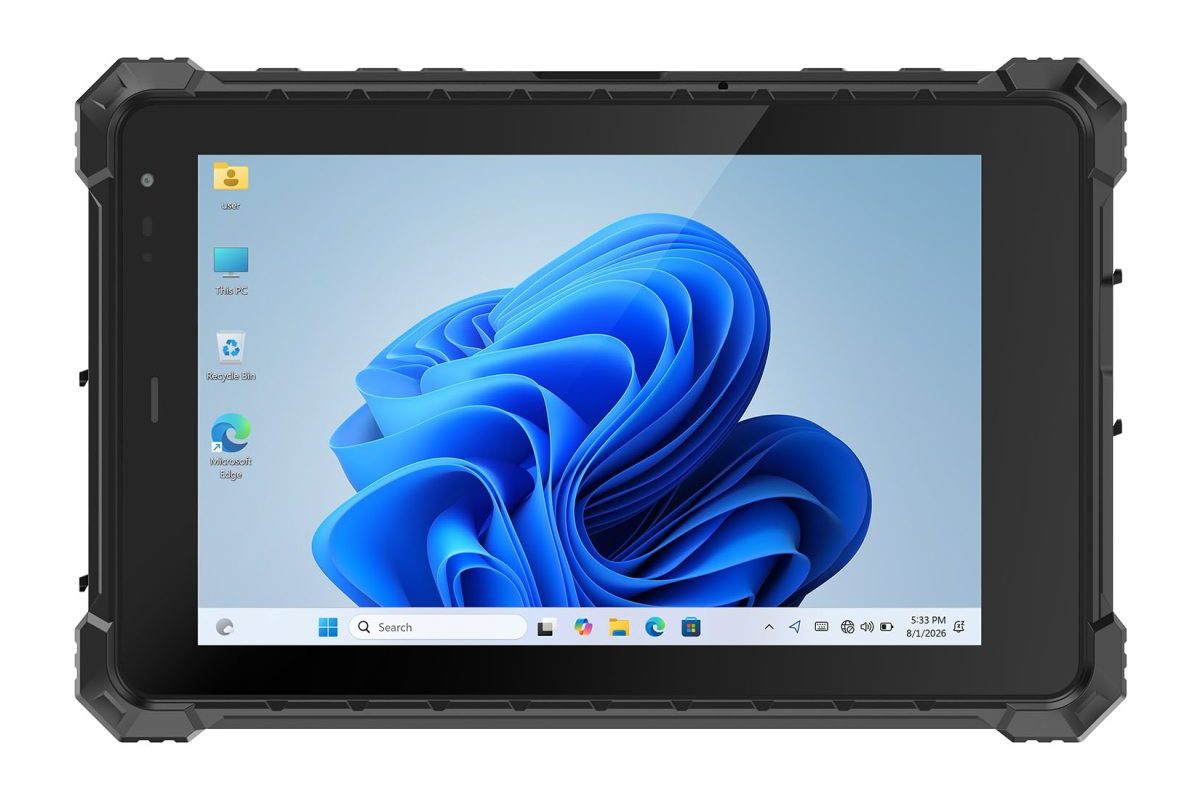
What separates a rugged tablet from a consumer tablet
A consumer tablet is designed for a living room. A rugged tablet is designed for a truck, a warehouse, a construction site or a factory floor. The difference is not a thicker case — it is the display, battery, sealing, scanner, wireless stack and lifecycle behind the device.
This guide explains the specifications that matter when buying rugged tablets for field service, logistics, construction and industrial inspection.
The six specifications that decide the device
1. IP rating and drop resistance
IP65 protects against dust and water jets; IP67 allows temporary immersion. For outdoor and industrial use, IP65 is the minimum and IP67 is common. Drop resistance is usually quoted against MIL-STD-810H, but the test conditions matter: a 1.2 m drop onto plywood is not the same as a 1.5 m drop onto concrete. Ask for the test report, not just the logo.
2. Display readability
Field workers use tablets in sunlight. A 500-nit display is difficult to read outdoors; 700–1,000 nits with anti-glare glass is the practical range. Also check touch performance with gloves and wet fingers, because a capacitive screen tuned for bare fingers will fail in rain or with work gloves.
3. Battery and hot swap
A full shift is eight to twelve hours. Look for a battery that supports hot swap, so the device keeps running while the pack is replaced. For fleet deployments, a charging dock and a spare-battery policy are part of the total cost.
4. Scanner and data capture
Logistics and retail projects usually need a 1D/2D barcode scanner, NFC or RFID. Integrated scanners are more reliable than Bluetooth accessories but add cost. Decide whether the scanner is used occasionally or all day.
5. Connectivity
Wi-Fi 6, 4G LTE and optional 5G, plus GNSS for field service. Check the supported bands for your region; a device that works in Europe may not cover the LTE bands used in North America or the Middle East.
6. Operating system and lifecycle
Android updates are shorter than most industrial deployments. Windows 11 IoT Enterprise offers a longer support window. Ask how long the model will be available, whether the battery and dock will remain in supply, and whether the firmware can be locked down for enterprise management.
Android, Windows or Linux?
| Platform | Best fit | Considerations |
|---|---|---|
| Android | Scanning, field apps, inspections, logistics | Lower cost, touch-first, shorter OS support; choose a vendor with a long model lifecycle |
| Windows 11 | Legacy software, CAD, full desktop applications | Higher cost, more power, better compatibility with corporate IT |
| Linux | Custom appliances, kiosks, specialised controllers | Requires in-house software support |
Sizes: 8-inch, 10-inch, 12-inch and larger
8-inch tablets are preferred for one-handed use in scanning and field service. 10-inch tablets offer a better balance of screen area and portability. 12-inch and larger devices are used for drawings, maps, inspection forms and vehicle-mounted applications. 18.5-inch and 30.5-inch rugged tablets exist for specialised workstation use.
Total cost of ownership
Rugged tablets cost more upfront but usually cost less per year. A consumer tablet replaced every 18 months, plus cases, repairs and downtime, often exceeds the price of a rugged device that lasts five years. For fleet buyers, the calculation should include:
- Device price and accessories (dock, hand strap, charger).
- Replacement rate and repair cost.
- Battery replacement cycle.
- Software licensing and mobile device management.
- Downtime cost per field worker.
Common mistakes
- Buying on IP rating alone without checking drop test conditions.
- Choosing a display that is too dim for outdoor use.
- Forgetting glove and wet-finger touch requirements.
- Ignoring the LTE band plan for the target country.
- Assuming Android updates will last as long as the hardware.
How Seabird builds rugged tablets
Our rugged tablet range covers 8-inch to 18.5-inch models on Android, Windows and Linux, with IP65/IP67 sealing, sunlight-readable displays, hot-swappable batteries, optional 5G, barcode scanners and GNSS. We also supply panel PCs and industrial monitors for fixed installations.
Send us the application, the platform, the scanner requirement and the target quantity. We will recommend a model, provide a sample and quote a factory price.
Frequently asked questions
Is IP67 enough for outdoor use?
IP67 covers dust and temporary immersion. For rain and hose-down environments it is sufficient, but the device also needs a sunlight-readable display and a wide operating temperature.
Can a rugged tablet run Windows 11?
Yes. Windows rugged tablets are common for field service, CAD and legacy enterprise software. They cost more and use more power than Android models.
Do rugged tablets support barcode scanning?
Many models have an integrated 1D/2D scanner. If scanning is occasional, a Bluetooth scanner may be cheaper.
What is the typical warranty?
One year is standard, with extended warranties available. Check the battery and accessory warranty separately.